

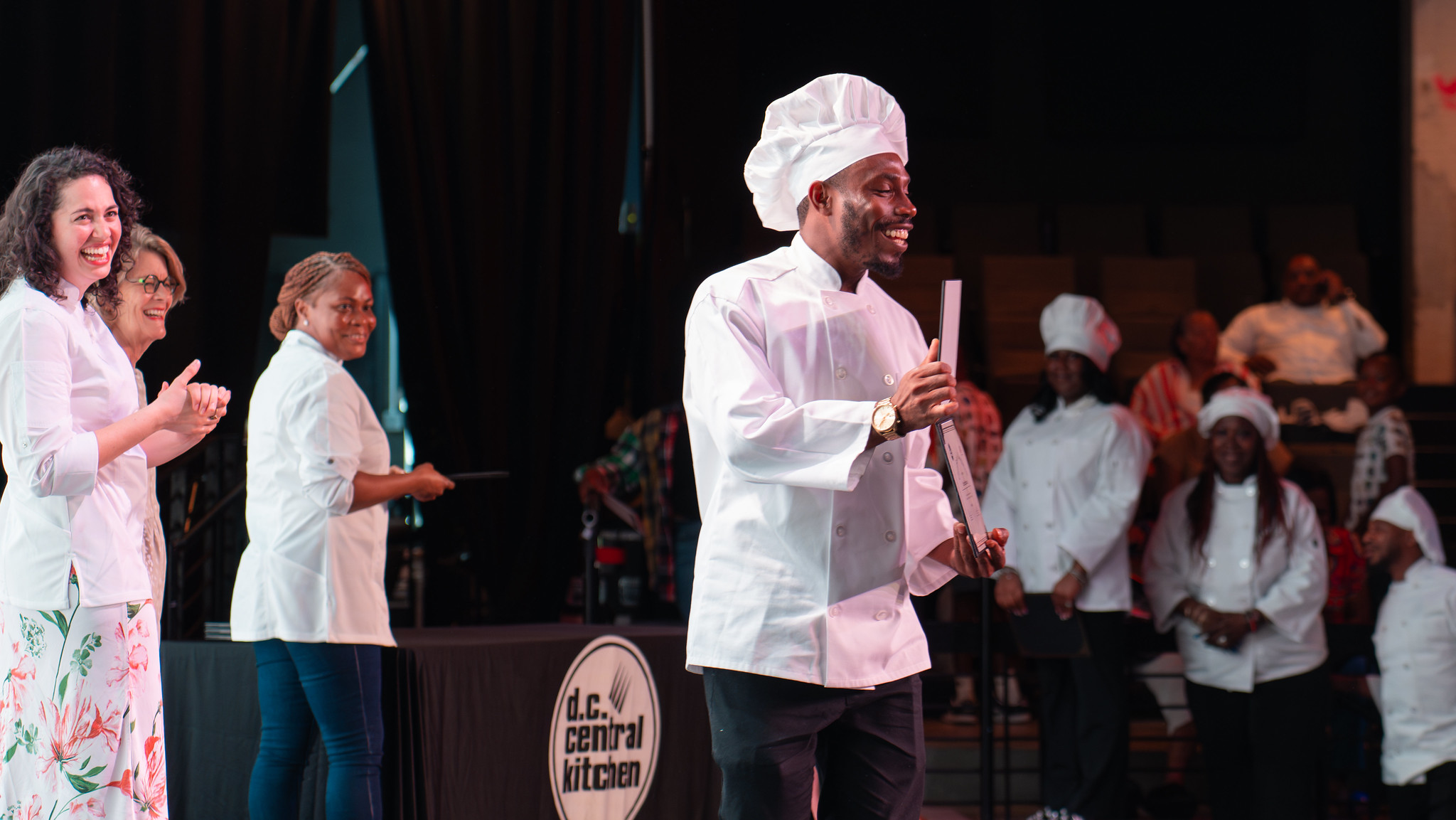
Success breeds success. Our Culinary Job Training students are visited by guest speakers from the worlds of restaurants, catering, finance, media, and other fields intertwined with the food and beverage industry. But the visitors that mean the most to the CJT students are the ones who have also sat in their seats.
Cortez came to DC Central Kitchen after 11 years and one month in the prison system. He says he enrolled in Class 173 of our Culinary Job Training program because, “I want better for my life, because I know I was young and I made mistakes. I came home and [now] I’m on my stuff.”
When we first interviewed Cortez in spring 2025, he had only been home for 60 days and was in his fifth week of our training program. His attitude was hopeful and positive, learning alongside and with his fellow classmates. “I feel as though we all elevate each other, because we all come from the same thing,” he said. “We all come from the same background, or you’ve been through it before, and you’re already doing better, just trying to do better. [My classmates] teach me each and every day.”
Other than his praise for the students in the program, Cortez was convinced he would work in a restaurant.
He succeeded. One year later, Cortez is working full-time in a restaurant in Dupont Circle alongside four of his fellow Class 173 graduates.
We invited Cortez to return to DC Central Kitchen for a visit and follow-up interview. The first thing he did was hug his old instructors and speak to the students in Culinary Job Training Class 179.
Our Culinary Arts Instructor Anand Shantam—herself a graduate of the program—greeted Cortez with open arms. She’s also grateful that graduates like Cortez are willing to share their stories with current students. “When they get to share their experience, their strength, and their hope, what they’ve gone through, how it benefited them, the good, bad, and different of what they experienced, it then shows the students, I can achieve this. I’ve been where they’ve been. It [gives] them a vision of where they can go.”
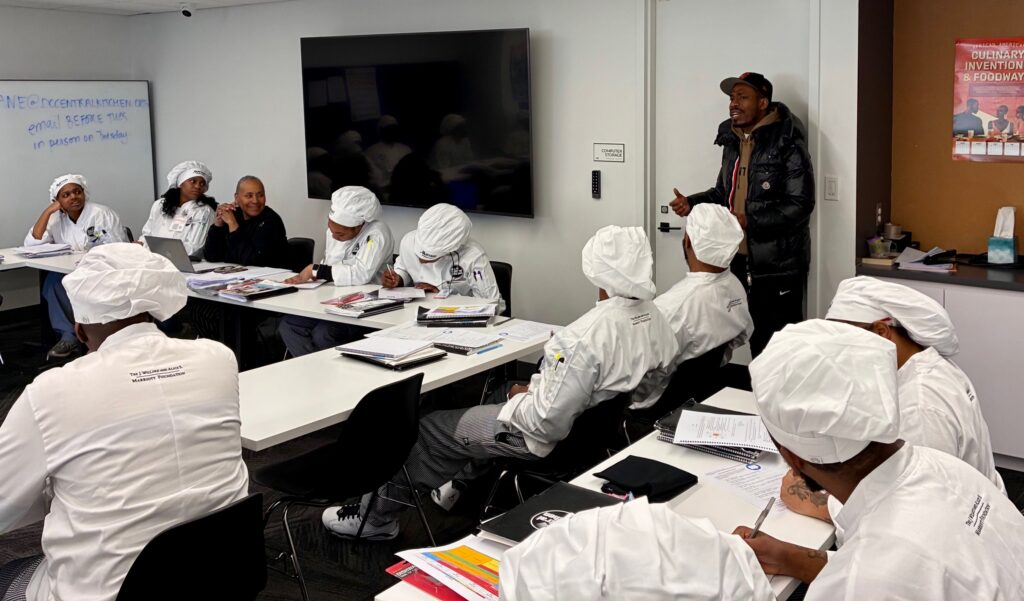
Speaking to Cortez this year, it’s evident his journey to and beyond DC Central Kitchen has been transformative. “As soon as I [first] came down here, I saw my childhood friend Willie. He told me, “This is the place to be.” He was saying it with authenticity. It was like I hit the jackpot.”
“Now in my life, I’m happy,” Cortez told us. “Everything I learned from DC Central Kitchen and the people I watched helped me because I saw it before I got in it. I just had to get the job myself and present my skills.”
Cortez went on to explain how a lesson stressed throughout the CJT program, mise en place, has guided how he now tries to keep ‘everything in its place’ not only in the kitchen, but in every aspect of his life. “When prepping in the kitchen, if everything is done the way it’s supposed to be and I’m communicating like how I learned from here, man, my job is easy.”
“I did not know what mise en place meant. That’s what I got here. Mise en place, it’s the best way it’s going to go. I like a smooth day. I like to know that I did everything I was supposed to do.”
In addition to embracing organization, Cortez’s work life benefits from his fellow CJT Class 173 graduates employed alongside him. “I feel like the Lakers with my team, they’ve got my back. I ain’t going to lie to you. My porter, he’s going to have my dishes ready, he’s going to do the trash. We’re going to communicate and talk. That’s what it’s all about.”
“We come from the same struggle. But right now, where we’re at? We’re at the best part. We’re doing good.” That’s the message he stressed to the current students.
“I was the same [as you]. I was in the same predicament. You’re going to try to do it your way. But at the end of the day, when you get here DC Central Kitchen, you see what’s already working and who already has a job. They’ve already been through it for you. They already did enough time for you. They already made enough mistakes for you. So they’re showing you. They’re pushing you. They’re going to help you.”
“He is an example of our success stories,” says Culinary Arts Instructor Anand. “This is a house of second chances that opens doors, where people become productive citizens, change their lives from the past that existed, that kept them unemployed, underemployed, addicted. There are dozens and dozens of examples of people to show that this can work.” And now, thanks to supporters like you, Cortez is one of them.